Breaking into the Energy Transition: Internships as a Policy Lever for Gender Equality

Elena Marabini
23 June 2026
Europe’s clean energy transition demands diverse talent to innovate and deliver equity, yet early-career entry points such as internships often sideline young women. This article explores internships as a strategic policy tool for gender equality, grounding the discussion in EU-wide data and STEM trends before focusing on the realities of the energy sector.
STEM Gender Gaps Globally
Women now outpace men in higher education across the EU, with 48% of women aged 25–34 holding tertiary degrees compared to 37% of men. Despite this, STEM fields remain largely male-dominated: women account for just 32.8% of STEM graduates and less than 30% of the global STEM workforce (European Commission, 2024a).
This imbalance is even more pronounced in the energy sector, where women represent around 25% of the total workforce and only 22% of research roles, with little distinction between renewable and traditional energy segments. While diverse teams consistently outperform in areas such as innovation and risk assessment—both essential for achieving net-zero targets—structural barriers such as implicit bias, unequal care responsibilities, and limited access to early professional opportunities continue to persist (International Energy Agency, 2023).
Energy Internships: Scarce and Uneven
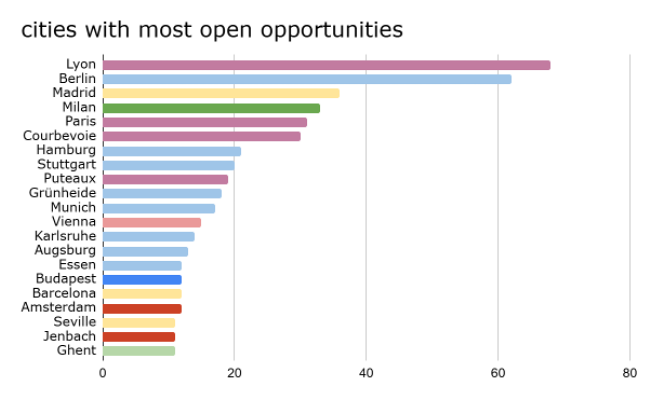
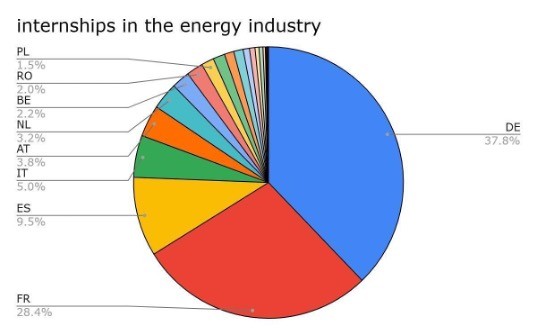
Access to internships represents a critical bottleneck. A September 2025 LinkedIn scan across EU27 countries identified only around 1,000 open energy internships, using filters such as “power,” “renewables,” “climate,” and “utilities.” These opportunities are not only limited in number but also highly concentrated: France and Germany alone account for nearly 70% of positions, largely driven by major players such as EDF and Framatome, while Southern and Eastern Europe offer significantly fewer opportunities.
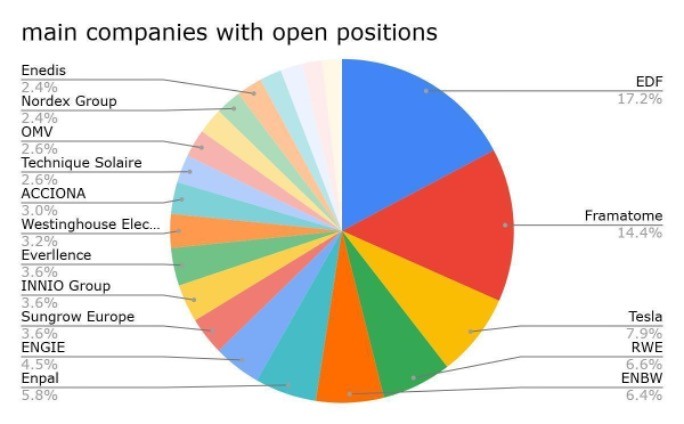
This distribution is closely linked to national industrial strategies. France, for instance, continues to invest heavily in nuclear research, reflecting the importance of this technology in its electricity mix and illustrating how targeted policy support can directly translate into early-career opportunities.
Geographically, internships tend to cluster in European capitals, research hubs, and international financial centres—locations characterised by higher innovation intensity. While this concentration may be economically efficient, it creates barriers for candidates who are unable to relocate, reinforcing existing inequalities in access.
At the same time, regulatory frameworks across the EU remain highly fragmented. While France requires internships to be paid after two months and Germany mandates compensation for voluntary placements exceeding three months, many countries still allow unpaid “curricular” internships with limited safeguards. At the EU level, this lack of harmonisation has prompted new policy action, including a proposed directive aimed at improving working conditions and preventing the misuse of internships as disguised employment (European Commission, 2024b; European Parliament, 2024).
Disproportionate Impact on Women
These structural and regulatory dynamics have a disproportionate impact on women. Unpaid or remote internships tend to affect them more strongly, as they are more likely to face unpaid care responsibilities and mobility constraints. Over time, this contributes to a form of self-selection out of technical career paths, reinforcing male dominance in leadership positions and decision-making spaces.
Recognising these challenges, EU initiatives have begun to address internship quality. The 2014 Quality Framework for Traineeships established principles such as written agreements and fair working conditions, while the pending Traineeships Directive goes further by proposing mandatory pay, mentorship requirements, and anti-discrimination measures to curb exploitation and improve access (European Commission, 2024b).
Concrete Policy Recommendations
Addressing these issues requires coordinated action across multiple actors. Governments and EU institutions should prioritise the enforcement of minimum standards, for instance by leveraging ESF and ERDF funding to support paid regional internships and by systematically tracking outcomes such as hiring rates among underrepresented groups.
Companies also have a key role to play. Increasing transparency in internship postings—clearly stating compensation, mentorship structures, and career prospects—would help level the playing field, while targeted outreach could expand access to women and candidates from underrepresented regions.
Universities, as intermediaries between students and industry, should take a more active role in mapping available placements, setting minimum compensation standards, and supporting mobility for students with fewer financial resources. At the same time, professional networks can contribute by sharing opportunities and providing mentorship to candidates from underserved backgrounds.
Taken together, these measures position internships not as peripheral experiences, but as a central lever for achieving gender-balanced energy leadership. By broadening access to early-career opportunities, they can strengthen talent pipelines and support a more inclusive and effective energy transition.
References
- European Commission (2024a). She Figures 2024: Gender in Research and Innovation. Publications Office of the European Union.
- European Commission (2024b). Proposal for a Directive improving and enforcing working conditions of trainees and combating regular employment relationships disguised as traineeships.
- European Parliament (2024). EU traineeships directive briefing.
- International Energy Agency (2023). Skills Development and Inclusivity for Clean Energy Transitions.
Related contents



Stay in the know
Get the Lights on Women newsletter.